A naive question runs through all of vaccine immunology: why do some vaccinations protect for decades, while others require regular boosters? The answer does not read off a simple antibody titer. Behind the circulating immunoglobulins stands a population of silent but mobilizable cells, memory B lymphocytes, whose composition, maturity and longevity determine an essential part of protection.
These cells are rare, heterogeneous, and long remained difficult to study other than through population averages. The arrival of single-cell sequencing, coupled with receptor repertoire analysis, changed that: a memory cell can now be identified, its receptor read, the clones it belongs to reconstructed, and their history retraced. This article sets out what that reading brings, through three pieces of work Inovarion contributed to — one of them on memory cells still identifiable more than forty years after a smallpox vaccination.
What B cell memory adds to circulating antibodies
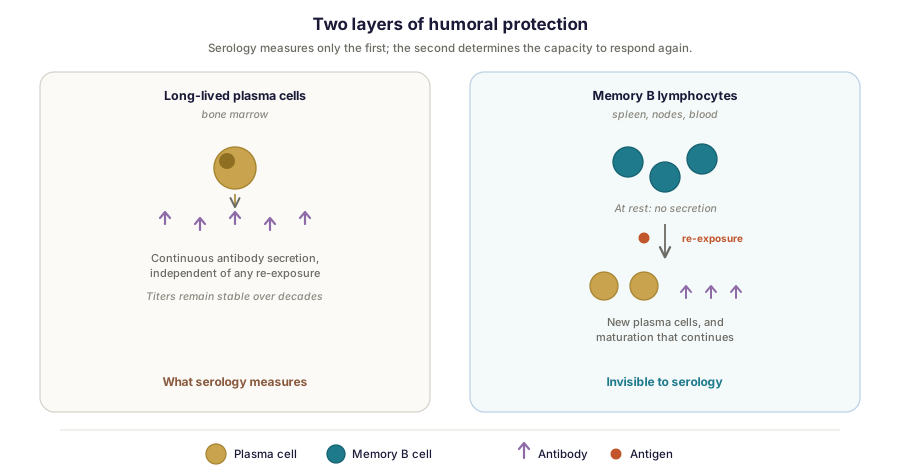
Humoral protection rests on two distinct compartments, and that distinction is the key to all the rest. On one side, long-lived plasma cells, settled mainly in the bone marrow, continuously secrete antibodies that patrol the blood: this is the first line, immediately available. On the other, memory B lymphocytes secrete nothing under normal circumstances, but reactivate rapidly on renewed encounter with the antigen, in turn producing plasma cells and continuing their maturation.
The timescales involved are remarkable, and they have been quantified. Longitudinal follow-up of viral and vaccine antigens in 45 subjects, over a period of up to 26 years, showed antiviral antibody responses of striking stability: estimated half-lives range from about 50 years for varicella-zoster virus to more than 200 years for measles and mumps [2]. In the case of smallpox vaccination, more than 90% of people vaccinated 25 to 75 years earlier still retained substantial humoral or cellular immunity against vaccinia; antibody responses remained stable across that whole period, while T cell responses declined slowly, with an estimated half-life between 8 and 15 years [1].
The practical consequence is important: measuring an antibody titer does not measure protection. A declining titer does not mean memory has disappeared, and a high titer does not guarantee that the repertoire will recognize a variant. The two compartments follow different logics, and they have to be interrogated separately.
The methodological problem: a rare and heterogeneous population
Studying antigen-specific memory B lymphocytes poses a difficulty of scale. These cells represent a minute fraction of lymphocytes. They moreover reside largely in secondary lymphoid organs — the spleen is a major reservoir of memory B cells — whereas it is peripheral blood that is accessible in practice in humans. At such frequencies, any measurement averaged over a population is blind: the signal from the cells of interest is drowned.
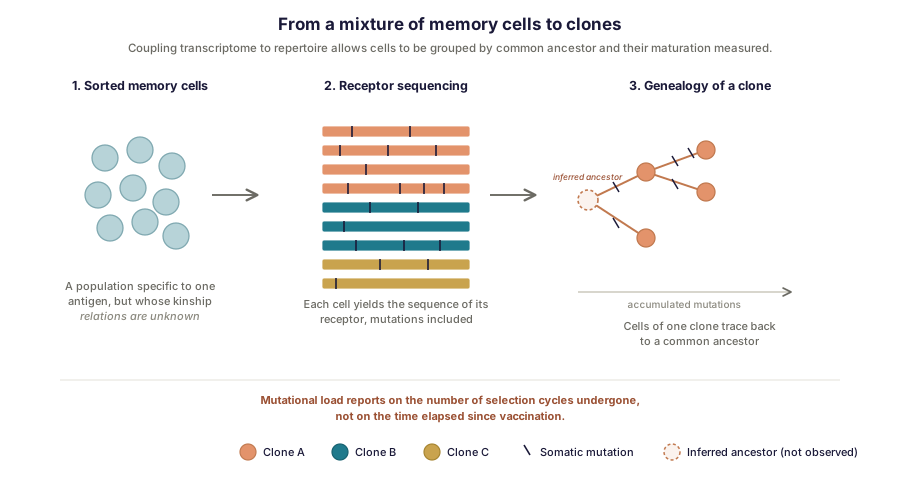
Single-cell sequencing lifts that obstacle, but its real contribution here lies in its coupling with repertoire analysis. Each B lymphocyte carries a unique receptor, arising from the rearrangement of its immunoglobulin genes and then modified by somatic hypermutation during maturation. Sequencing that receptor at the same time as the cell’s transcriptome allows three things no bulk approach allows: grouping cells descended from a common ancestor into clones, measuring the intensity of affinity maturation by counting accumulated mutations — which report on the number of selection cycles undergone, not on elapsed time — and relating all of this to the functional state of each cell.
In other words, one no longer merely notes the presence of memory: its history can be read. This is the direct extension of the distinction we develop in relation to the choice between single-cell and bulk sequencing — here, the average masks not only heterogeneity, it erases genealogy.
First case: memory cells forty years after vaccination
Smallpox vaccination offers immunology an experimental design one could not deliberately devise. Smallpox having been eradicated, vaccination ceased, and the authors were able to use that timeline to select their donors: those born before 1970 had most likely received at least one smallpox vaccination, while those born after 1980 could not have been vaccinated. One thus has a natural cohort in which exposure is dated, and in which no re-exposure could have sustained memory.
Work Inovarion contributed to exploited this situation [3]. From the spleens of organ donors, the team isolated memory B lymphocytes specific for the B5 protein of vaccinia virus, in people vaccinated more than forty years earlier, and characterized them by single-cell sequencing and repertoire analysis.
The results draw a precise, and partly unexpected, portrait. Only a handful of clones persisted over such a span, with limited intraclonal diversity and signs of extensive affinity-based selection: what remains after forty years is not a representative sample of the initial response, but the product of severe pruning. These cells prove enriched in a particular splenic subpopulation, CD21hi CD20hi IgG+, carrying a marginal-zone-like transcriptional signature driven by the NOTCH and MYC pathways.
Two results run against intuition.
The first is negative: these cells possess no transcriptional or metabolic profile specific to longevity. One might have expected to find a molecular program of the “long-lived cell”, an active signature explaining their survival. It does not exist. What is found instead are the two elements the study’s title foregrounds: the lasting imprint left by the germinal center of origin, and the dynamic interactions within the splenic niche that houses them. In other words, longevity does not rest on a survival program the cell would run continuously, but on what it acquired once and for all, and on the environment that sustains it.
The second is more surprising still: the telomeres of these memory cells are longer than those of naive B lymphocytes from the same donor. The observation seems counterintuitive, since telomeres normally shorten with each division, and these memory cells descend from naive cells that proliferated intensely in a germinal center. The explanation is known: germinal center B lymphocytes express very high telomerase activity, several orders of magnitude above that of naive or memory cells, which lengthens their telomeres during the reaction; their memory progeny retain part of it. That lengthening is today considered a condition of the lifelong capacity to re-amplify a few antigen-specific cells, or even a single one, on renewed encounter.
What telomere length reveals is therefore not an absence of divisions, but an investment made upstream: the replicative potential these cells will need forty years later was conferred on them at the moment of the germinal center. The two results then converge on one conclusion, the one the study’s title carries: the longevity of this memory rests not on a cellular state of survival, but on the lasting imprint left by the reaction that generated it.
Second case: what mRNA vaccination produces
The smallpox case describes an old memory. What remains to be understood is what a contemporary vaccination generates, and of what quality. mRNA vaccination against SARS-CoV-2 provided an unprecedented opportunity to observe memory being built in real time, in large, well-characterized cohorts.
A second piece of work Inovarion contributed to compared two situations: naive people who were vaccinated, and people who had recovered from COVID-19 and were then vaccinated [4]. The question asked was that of the quality of the memory generated — do the cells produced recognize variants of the virus, and does the repertoire differ according to whether the individual had already encountered the antigen? The result, as the study’s title summarizes it, is that vaccination elicits potent memory B cells capable of recognizing SARS-CoV-2 variants.
The message goes beyond the COVID-19 context: a vaccination does not reduce to the production of antibodies, it shapes a repertoire. And the nature of that repertoire, its breadth of recognition in particular, conditions future protection against versions of the pathogen that did not yet exist at the time of vaccination.
Third case: maturation continues after exposure
A third piece of work completes the picture by introducing the dimension of time. Following, by single-cell sequencing and repertoire analysis, the B cell response of patients with mild and severe forms of COVID-19 for up to six months, the study showed that memory does not merely persist: it matures [5]. Longitudinal follow-up reveals a response that continues to evolve over several months, well after the acute phase of infection.
This result illuminates the first case retrospectively. The affinity-based selection observed in the surviving smallpox clones after forty years is the distant trace of that same process. The limited intraclonal diversity they display suggests that maturation did not continue indefinitely, for want of re-exposure to the antigen. The three studies in fact describe three snapshots of a single trajectory: a memory that forms, that refines itself, and a highly selected fraction of which crosses the decades.
What this changes for vaccine evaluation
These studies converge on an operational conclusion. Reducing the evaluation of a vaccine to an antibody titer measured a few weeks out means ignoring the layer of protection on which duration depends, and forgoing any signal about future robustness.
A more informative evaluation interrogates the quality of the repertoire: how many distinct clones were engaged, what their degree of maturation is, what breadth of recognition they show against antigenic variants, and what fraction carries the characteristics associated with persistence. These parameters are not obtained by serology; they demand a cell-by-cell reading coupled with the repertoire.
What this kind of study requires
The difficulty is real and arises first upstream. A rare population has to be accessed, which requires cell sorting based on antigen specificity, with rigorous controls: a major source of error in this kind of work is taking cells to be specific when they are not.
Downstream, the analytical chain is demanding. The heavy and light chain sequences of the receptor must be assembled for each cell, clones defined by explicit criteria, genealogical relationships between cells of a clone reconstructed, hypermutation quantified, then this repertoire information integrated with the transcriptomic data. Every step involves methodological choices that influence the conclusion. It is this articulation between fine experimentation and rigorous computational analysis that makes the value of an immune memory study.
How Inovarion can support you
Inovarion supports studies of lymphocyte memory and vaccine response, from design to interpretation: defining the sorting strategy and specificity controls, cytometry and isolation of rare populations, single-cell sequencing coupled with repertoire analysis, then integrated bioinformatic analysis — clone definition, phylogenetic reconstruction, quantification of maturation, integration with the transcriptome. Our teams have contributed to reference work on human B cell memory, from recent vaccine responses to persistence across several decades.
Publications
Field references
- Hammarlund E, Lewis MW, Hansen SG, et al. Duration of antiviral immunity after smallpox vaccination. Nature Medicine, 2003;9(9):1131-1137. PubMed
- Amanna IJ, Carlson NE, Slifka MK. Duration of humoral immunity to common viral and vaccine antigens. The New England Journal of Medicine, 2007;357(19):1903-1915. DOI
Inovarion contributions
- Chappert P, Huetz F, Espinasse MA, et al. Human anti-smallpox long-lived memory B cells are defined by dynamic interactions in the splenic niche and long-lasting germinal center imprinting. Immunity, 2022;55(10):1872-1890.e9. Record → · PubMed
- Sokal A, Barba-Spaeth G, Fernández I, et al. mRNA vaccination of naive and COVID-19-recovered individuals elicits potent memory B cells that recognize SARS-CoV-2 variants. Immunity, 2021;54(12):2893-2907.e5. PubMed
- Sokal A, Chappert P, Barba-Spaeth G, et al. Maturation and persistence of the anti-SARS-CoV-2 memory B cell response. Cell, 2021;184(5):1201-1213.e14. Record → · PubMed
updated July 2026