Our understanding of hemostasis owes much to monoclonal antibodies: selectively blocking a coagulation protein, quantifying it in plasma, neutralizing its activity — operations that shaped the field. For some twenty years an alternative from camelids has established itself alongside them. Single-domain antibodies, often designated by the abbreviation VHH, are ten times smaller than a conventional antibody, simpler to produce, and able to reach recesses of the protein surface that a whole antibody cannot approach. That last property is no technical detail: it opens uses that were out of reach. This article sets out what these molecules are, what their small size makes possible, and how they serve today in turn as a research tool, a diagnostic reagent and a therapeutic candidate in hemostasis — to the point of becoming, through engineering, building blocks from which molecules with unprecedented properties are assembled.
What is a single-domain antibody?
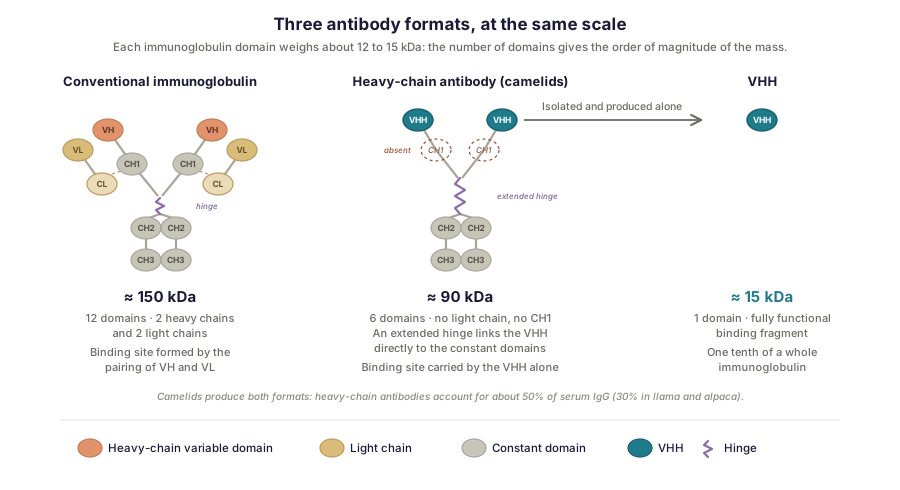
The story begins in 1993, with an unexpected observation. Analyzing dromedary serum, a Brussels team found a notable quantity of immunoglobulin-like material of about 100 kilodaltons, made of heavy chain dimers and devoid of light chains — even though these molecules retained a broad antigen-binding repertoire [1]. The finding called into question the role attributed to light chains, and the authors already concluded that it opened new prospects for antibody engineering. They were not wrong.
A conventional antibody is an assembly of two heavy chains and two light chains, of about 150 kilodaltons, whose recognition site is formed by the meeting of two variable domains. Camelids produce, in addition to these classical antibodies, heavy-chain-only antibodies, devoid of light chains and of the first constant domain. In these, the entire recognition capacity resides in a single variable domain. Isolated and produced on its own, that domain, the VHH, constitutes a fully functional binding fragment of about 15 kilodaltons, a tenth of a whole immunoglobulin.
A word on terminology, which invites confusion. One encounters “VHH”, “single-domain antibody” or its abbreviation sdAb, and “nanobody” — the last being a registered trademark rather than a generic term. We will use VHH and single-domain antibody here.
What small size makes possible
The practical advantages follow almost directly from the structure. A VHH is encoded by a single sequence, which allows it to be produced simply in a microbial system, at low cost, without the assembly machinery a complete antibody requires. Its stability is remarkable, and its single-domain format makes it an ideal engineering block: it can be multimerized, fused, or paired with a second domain of different specificity — we return to this below.
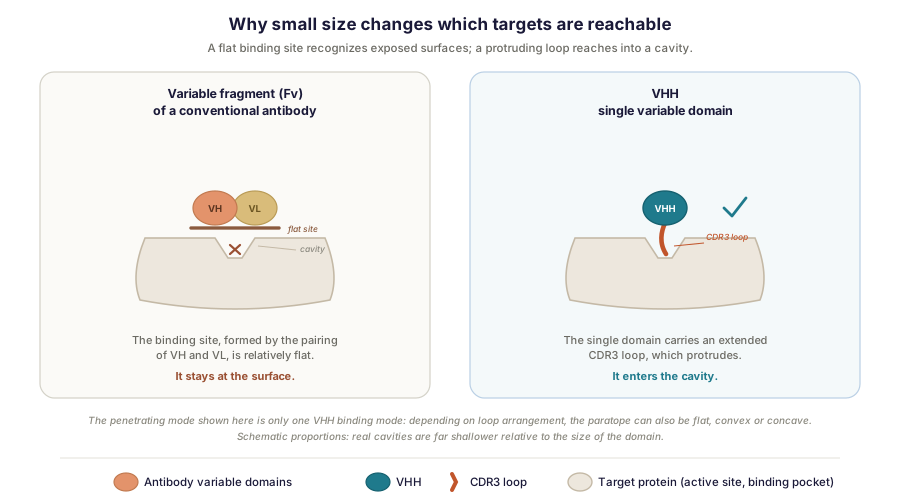
But the decisive advantage lies elsewhere. Because it is small and its recognition loop is often elongated, a VHH can lodge in cavities and grooves of the protein surface inaccessible to a whole antibody. It thus recognizes epitopes that classical monoclonal antibodies cannot reach [2]. This capacity has a consequence still poorly appreciated: it makes it possible to distinguish conformational variants of one and the same protein. Where a conventional antibody measures a quantity, a well-chosen VHH can measure a state — recognizing, for instance, the active form of a factor but not its globular form, or a free protein but not the same protein engaged in a complex.
This is what makes the class so interesting in hemostasis, a discipline whose proteins constantly change conformation, assemble, are cleaved, and circulate in functionally distinct forms.
Research tool: dissecting mechanisms
The first use, historically and logically, is as an experimental tool. VHHs directed against coagulation proteins have made it possible to settle difficult biochemical questions [2]: selectively blocking one domain without disturbing the others, freezing or revealing a particular conformation, mapping an interaction interface. Their small size limits steric hindrance, which makes them finer than whole antibodies for probing a mechanism without denaturing it.
This methodological base feeds directly into the two applications that follow: a VHH validated as a research probe is often the starting point for a diagnostic reagent or a therapeutic candidate.
Diagnostic reagent: measuring a state, not just a quantity
The classical assay of a hemostasis protein reports its concentration. It rarely says what state it is in — intact or cleaved, active or latent, free or complexed. This is where the conformational sensitivity of VHHs becomes a diagnostic lever.
Work Inovarion contributed to provides an accomplished demonstration. Von Willebrand factor (VWF) is a multimeric protein whose size is regulated by the protease ADAMTS13, which cleaves it within its A2 domain. And it is multimer size that conditions the hemostatic function of VWF: their loss is associated with a bleeding phenotype. The team developed a VHH, KB-VWF-D3.1, directed against the collagen-binding site in the A3 domain — an epitope whose exposure changes when VWF is proteolyzed. The VHH loses its binding after cleavage by ADAMTS13, which makes it, in effect, a marker of intact VWF [5].
The results obtained in patients illustrate the value of that reading. The reagent detected VWF degradation in von Willebrand disease, with a significant correlation between the proportion of high-molecular-weight multimers and the level of intact VWF. Above all it revealed increased proteolysis in some type 1 and type 2M patients, which was not expected and suggests that the degradation mechanism contributes to forms of the disease where it was not suspected. The tool also showed its value beyond inherited von Willebrand disease: reduced levels of intact VWF were found in patients with severe aortic stenosis and in patients on mechanical circulatory support — two situations of acquired von Willebrand disease linked to shear stress.
A tool designed for research thus becomes a test capable of informing a difficult diagnosis.
Therapeutic candidate: from inhibition to rebalancing
The third family of use is therapeutic, and the class has already crossed into the clinic: caplacizumab, a homodimeric VHH directed against von Willebrand factor, is approved for the treatment of acquired thrombotic thrombocytopenic purpura [2]. Proof of concept has therefore been established.
A more recent strategy illustrates the conceptual flexibility this format allows. In hemophilia, the classical approach consists of replacing the missing coagulation factor. Another piece of work Inovarion contributed to explored the reverse route: rather than adding a procoagulant, inhibiting a natural anticoagulant to rebalance hemostasis. The target chosen is antithrombin, and the inhibitors are llama-derived single-domain antibodies [6]. Two VHHs combined into a single recombinant protein restored thrombin generation in hemophilic plasma, then corrected the bleeding phenotype in mice — including in the presence of inhibitors, a particularly difficult clinical situation. Prolonged hepatic expression obtained by an AAV8 vector proved well tolerated and associated with lasting correction in models of hemophilia A and B.
One detail turns a weakness into an asset. Safety is the main obstacle for so-called rebalancing therapies: by lowering the natural brakes on coagulation, they expose patients to thrombotic risk, which has delayed or halted several clinical programs in this class. Now the short plasma half-life of VHHs, usually presented as a limitation, offers room for maneuver here: the effect stops quickly, and it is reversible by infusion of antithrombin concentrate. Reversibility therefore comes from the format itself, not from an added device. An approach that durably lowers antithrombin levels (by RNA interference, for instance) obtains its effect through a mechanism whose duration is what makes it less modulable: these are two different profiles, to be weighed against the risk one accepts.
The field has not stopped there. Single-domain antibodies are today presented as the “new revolution” in hemophilia treatment, after that of bispecific antibodies mimicking activated factor VIII [4]. The same review notes an orally bioavailable bispecific VHH (Inno8), in clinical trial at the time of writing, with the ambition of offering protection comparable to injectable treatments with the convenience of a daily oral dose [4]. And the prospect is notable: it is the stability and small size of the single-domain format that make conceivable a route of administration inaccessible to a conventional antibody.
Engineering: what you build with 15-kilodalton blocks
The single-domain format lends itself to assemblies a whole antibody does not permit. Valences can be multiplied to increase avidity, two specificities combined in one molecule, or a domain grafted on whose function is to prolong circulation.
A recent example illustrates this logic perfectly, by answering precisely the half-life limitation mentioned above. To treat type 1 von Willebrand disease, characterized by a quantitative VWF deficiency, a team designed a bispecific VHH, KB-V13A12: it combines a domain directed against the D’D3 region of von Willebrand factor and a llama-derived anti-albumin domain that recognizes human as well as murine albumin [3]. The idea is not to supply VWF from outside, but to slow the elimination of endogenous VWF by tethering it to albumin — a protein whose very long half-life comes from its cellular recycling.
The results specify the mechanism, and that is where the interest lies. A single subcutaneous dose of 5 mg/kg, for a molecular half-life of about three days, raises VWF levels by a factor of 1.4 to 2.1 for up to two weeks, with a concomitant rise in factor VIII activity. The VWF propeptide-to-antigen ratio, a clearance marker, is significantly reduced, which points toward slower elimination rather than increased production. The decisive demonstration comes from a loss-of-function experiment: the prolonged survival of VWF in the presence of the VHH disappears in mice deficient in the FcRn receptor. It is therefore recycling mediated by that receptor — the same that gives albumin and immunoglobulins their circulatory longevity — that explains the effect. The bleeding tendency is significantly improved as a result.
This evaluation would not have been possible without a fully humanized mouse model of the disease, developed with Inovarion’s contribution [7]: a candidate directed against human von Willebrand factor does not recognize its murine homolog. It is a direct illustration of the articulation between molecular tools and preclinical models that we develop in our guide to in vivo preclinical models.
Limits and points of vigilance
This class is not without constraints, and knowing them conditions the success of a project. Plasma half-life is short, owing to rapid renal clearance linked to small size: without recourse to engineering, exposure remains brief. Camelid origin raises a question of potential immunogenicity in humans, addressed by humanizing the sequences, at the cost of additional validation work.
Two points finally remain to be settled upstream. Specificity must be established rigorously: the ability to recognize unusual epitopes is an asset, but it requires checking closely what is recognized, and in which conformational state. And cross-species reactivity must be documented early: a VHH directed against a human protein will not necessarily recognize its murine homolog, which conditions the very feasibility of preclinical evaluation.
How Inovarion can support you
Inovarion works on the characterization and functional validation of single-domain antibodies in hemostasis and thrombosis: epitope determination and conformational behavior, development and qualification of assays based on these reagents, in vitro evaluation on plasma and whole blood, and in vivo evaluation in relevant models — including humanized ones where the target requires it. Our teams support projects running from research probe to preclinically evaluated candidate, combining expertise in hemostasis, protein biochemistry and animal models.
Publications
Field references
- Hamers-Casterman C, Atarhouch T, Muyldermans S, et al. Naturally occurring antibodies devoid of light chains. Nature, 1993;363(6428):446-448. PubMed
- Peyron I, Kizlik-Masson C, Dubois M-D, et al. Camelid-derived single-chain antibodies in hemostasis: mechanistic, diagnostic, and therapeutic applications. Research and Practice in Thrombosis and Haemostasis, 2020;4(7):1087-1110. PubMed
- Peyron I, Casari C, McCluskey G, et al. A bispecific nanobody for the treatment of von Willebrand disease type 1. Blood, 2025;146(21):2597-2607. DOI
- Lenting PJ, Denis CV. The revolution of nanobodies and therapeutic antibodies in hemophilia. Bulletin de l’Académie Nationale de Médecine, 2026;210(5):565-570. DOI
Inovarion contributions
- Kizlik-Masson C, Peyron I, Gangnard S, et al. A nanobody against the VWF A3 domain detects ADAMTS13-induced proteolysis in congenital and acquired VWD. Blood, 2023;141(12):1457-1468. Record → · DOI
- Barbon E, Ayme G, Mohamadi A, et al. Single-domain antibodies targeting antithrombin reduce bleeding in hemophilic mice with or without inhibitors. EMBO Molecular Medicine, 2020;12(4):e11298. Record → · PubMed
- McCluskey G, Heestermans M, Peyron I, et al. A fully humanized von Willebrand disease type 1 mouse model as unique platform to investigate novel therapeutic options. Haematologica, 2025;110(4):923-937. Record → · PubMed
updated July 2026