The other articles in this section deal with measurement: reading a transcriptome, quantifying an immune infiltrate, identifying a metabolite. This one deals with construction — because the object often has to be built before the question can be asked. A mouse expressing a human protein, a cell line differing from another by a single variant, an antibody recomposed to reach a buried epitope: all of them constructs that make a measurement possible.
This activity borrowed its vocabulary and its ambitions from engineering. It also inherited a promise that biology does not keep, and it is that promise this article is about.
A promise borrowed from engineering
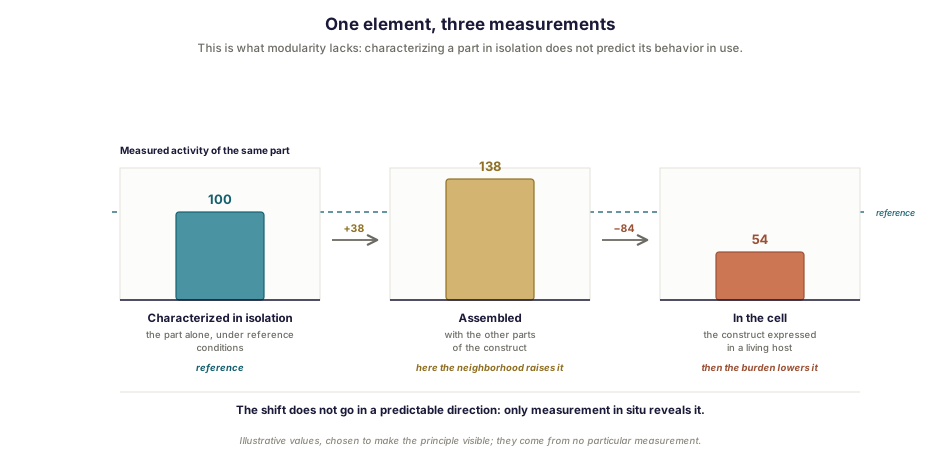
The founding ambition was clear: to have characterized, assemblable parts whose behavior can be deduced from that of their components. A given promoter, a given ribosome binding site, a given gene, and predictable expression.
That ambition presupposes modularity: that a part behaves the same way alone and assembled. This is what the interfacing between a construct and its host defeats, and this context dependence has been the subject of dedicated work [2]. The consequence is that predictability and independence of behavior, two things other engineering disciplines take for granted, are not given here.
A review devoted to the causes of failure in these systems draws a conclusion that can be taken at face value: their operation remains fundamentally circumstantial. The situation in which molecules and organisms find themselves shapes the way they interact and process information, and designers run into these effects “particularly when molecular and genetic devices inexplicably fail to function as designed when tested in vivo” [1].
The word inexplicably is not incidental. It does not mean the cause is unknowable, but that it does not lie where the design looked for it.
Two families of failure
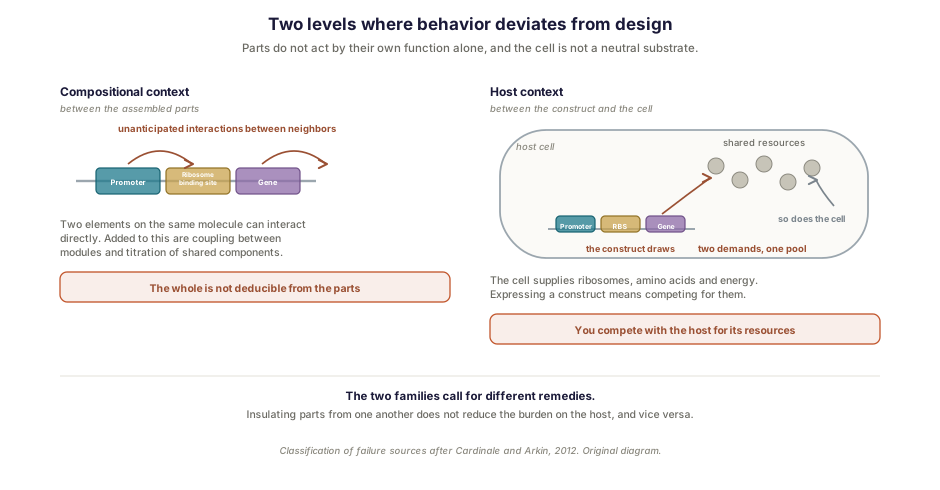
The same review sorts these divergences between design and actual function into two families, which call for different remedies.
Compositional context
The first arises because parts, once brought together, do not ignore one another. Two neighboring elements carried on the same molecule can interact directly without anything having anticipated it. And at a more functional level, coupling between modules, the titration of shared components, or what the authors call circuit “impedance” produce effects absent from each part taken in isolation [1].
The electronic analogy, from which the discipline has borrowed heavily, sheds light here on its own limit — but not where one would expect. In electronics too, adding a stage changes the behavior of the preceding ones: this is loading, and it is precisely why the authors speak of “impedance”. The difference lies elsewhere. The electronics engineer has standardized interfaces and buffer stages that make the effect predictable and correctable. Insulation devices exist on the biological side as well — an object of research in its own right, and one of the themes of the work cited above — but they do not reach that level of standardization. The analogy therefore holds; it is the remedy that transfers badly.
Host context
The second family arises from the cell itself [1]. It is not a neutral substrate onto which a function is deposited: it supplies the ribosomes, the amino acids, the energy — and you enter into competition with it for those resources.
The burden placed on the host
One study gave this second point a clear experimental basis.
Expressing a foreign protein from a construct constitutes an unnatural burden that cells are not adapted to. And the striking result is this: native promoters of the heat-shock response activate rapidly in response to synthetic expression, whatever the construct [4]. In other words, the cell does not react to what has been built; it reacts to the fact that something has been built.
The best-established consequence is slowed growth — indeed it is growth restoration that the feedback system described below is designed to achieve [4]. To this are added, in the routine practice of expression lines, a drift in expression levels over passages and the loss or silencing of the construct.
Remedies run in two directions, following the same logic. The first is to quantify the available cellular capacity in order to retain designs less costly to the host [3]. The second is to place expression under feedback control: since stress promoters signal the burden, they can serve as a sensor and automatically reduce expression when it becomes excessive, which the authors achieved by means of a dCas9-based feedback system [4].
Why the cycle is iterative by necessity
The discipline’s approach is often summarized as a cycle: design, build, test, learn, then start again. It is sometimes presented as good project-management practice. It is in fact a direct consequence of what precedes.
If the behavior of an assembly cannot be deduced from that of its parts, then it has to be measured. And if the measurement reveals a discrepancy, the construct must be modified and measured again. Iteration is not a methodological choice but the only way to make progress in a field where prediction remains partial.
This has a practical consequence best factored in from the outset: a construction project is sized in rounds, not in a deliverable obtained on the first attempt. The constructs thus obtained then serve measurement — as with the isogenic lines discussed in relation to iPSC-derived cell models, or the genome-editing tools covered in relation to screens.
A case: properties that each answer a use
Work Inovarion contributed to shows what a construct looks like when each of its properties corresponds to a specific use.
The aryl hydrocarbon receptor is a ligand-dependent transcription factor involved in xenobiotic metabolism, carcinogenesis, immune regulation and cell differentiation. Measuring its activity therefore matters, and had until then been done with a classical luciferase assay based on transient plasmid transfection or on stable cell lines.
The team built two new reporter genes: a histone 2B fused to a green fluorescent protein, and a secreted nanoluciferase [7].
What is of interest is not the number of constructs but the correspondence between their properties and the uses they allow. The nanoluciferase is secreted, so that measurement requires only a small volume of culture medium — the recognized advantage of secreted reporters: measuring without lysing the cells, and therefore being able to repeat the measurement on the same culture. The fluorescent reporter is nuclear, which makes it suited to live-cell imaging. And the whole works in 96- and 384-well plates, which opens the way to screening agonist or antagonist compounds — a logic we develop in relation to screens.
To each property of the construct there thus corresponds a use made possible. Whether that correspondence was sought from the outset or emerged along the way, the publication does not say; it does point to a practical orientation in the face of the problem set out above: since the behavior of an assembly cannot be deduced from its parts, it is more productive to start from the measurement you want to obtain than to assemble characterized parts and hope the result will do.
This orientation does not remove the rounds discussed in the previous section; it gives them a criterion. The question asked at each round ceases to be “does the construct behave as designed?” — which non-modularity forbids answering in advance — and becomes “is it usable for the intended measurement?”, which experiment can answer.
Leaving the host: cell-free systems
One approach tackles the second family of failure head-on.
Cell-free protein synthesis carries out transcription and translation outside any cell, from extracts or reconstituted components. By removing the membranes and the parts of the cell that do not serve the purpose, it makes it possible to dissect and manipulate expression directly, with rapid feedback [5].
The gain is exactly what this article’s logic predicts: removing the host removes host context. No more competition for vital resources, no more burden placed on an organism that must also grow, no more drift through selection. Compositional context, on the other hand, remains, since the parts continue to interact with one another.
The price is paid elsewhere: limited operating time, no replication, and an environment that has to be reconstituted rather than inherited.
A constraint that does not come from the laboratory
One final point, often discovered at the moment it delays a project.
Every order of synthetic DNA passes through sequence screening at the supplier. This control mechanism was built around resemblance to known agents: the supplier assesses whether an ordered sequence resembles pathogens or regulated agents.
That model is currently being reassessed, because AI-assisted design tools widen the space of sequences that may be proposed [6]. The debate concerns the governance of this checkpoint and falls outside the scope of this note; what matters in practice is simpler: the constraint exists, it is evolving, and the delays it entails are better planned for than endured.
What to plan for in a project
Five points sum up what precedes.
Characterize parts in the context where they will be used, not in isolation — a measurement obtained alone does not predict behavior in the assembly. Measure the burden placed on the host, rather than discovering it through slowing growth. Size the project across several rounds. Check stability over time, since a construct that works in early passages may be lost later. And build the ordering and sequence-screening lead times into the schedule.
How Inovarion can support you
Synthetic biology is among the molecular biology approaches Inovarion implements, alongside CRISPR-Cas9 genome editing and RNA sequencing, and our teams have contributed to the design of reporter systems intended for measurement and screening. On projects of this kind the useful questions arise before construction: what behavior must be obtained, and in what context of use will it be measured? What burden can the host bear? And how many rounds does the schedule allow? It is on these trade-offs that the difference is decided between a construct that works at characterization and one that works in use.
Publications
Field references
- Cardinale S, Arkin AP. Contextualizing context for synthetic biology — identifying causes of failure of synthetic biological systems. Biotechnology Journal, 2012;7(7):856-866. DOI
- Del Vecchio D. Modularity, context-dependence, and insulation in engineered biological circuits. Trends in Biotechnology, 2015;33(2):111-119.
- Ceroni F, Algar R, Stan GB, Ellis T. Quantifying cellular capacity identifies gene expression designs with reduced burden. Nature Methods, 2015;12(5):415-418. DOI
- Ceroni F, Boo A, Furini S, et al. Burden-driven feedback control of gene expression. Nature Methods, 2018;15(5):387-393. DOI
- Yue K, Chen J, Li Y, Kai L. Advancing synthetic biology through cell-free protein synthesis. Computational and Structural Biotechnology Journal, 2023. DOI
- Wittmann BJ, Wheeler NE, Murphy ST, et al. The limits of sequence-based biosecurity screening tools in the age of AI-assisted protein design. Frontiers in Bioengineering and Biotechnology, 2026;14:1858951. DOI
Inovarion contribution
- Degrelle SA, Ferecatu I, Fournier T. Novel fluorescent and secreted transcriptional reporters for quantifying activity of the xenobiotic sensor aryl hydrocarbon receptor (AHR). Environment International, 2022;169:107545. Record → · DOI
updated July 2026